
Modifiers Explained
Reusable validation logic, modifier ordering, and parameter pass-through execution.
Let's address the classic Web2 refactoring habit:
When you are writing APIs in Node.js or Python, you frequently use middleware to check permissions, validate request parameters, or check session states. You write a clean decorator like @admin_required or pass a list of middleware functions to your express route definitions.
When developers start writing Solidity, they often write the same manual check blocks inside every single function:
I genuinely did this in my early contracts, copying the same three lines of require gates across twenty different functions, cluttering the logic and introducing maintenance bugs.
The solution is Modifiers—Solidity's native method decoration middleware.
1. The Metaphor: The Security Turnstile Gate
Think of a function modifier as a physical Security Turnstile Gate placed at the entrance of a building:
- The Target Room (The Function Body): The room you want to enter to execute work (e.g. transfer funds or change a settings variable).
- The Turnstile (The Modifier): A physical gate placed before the door. To pass through, you must swipe your badge, pass an alcohol breathalyzer check, or pay an entry fee.
- The Placeholder
_;(The Door Opening): In Solidity, the modifier contains a special symbol: a single underscore followed by a semicolon_;. This symbol acts as the release signal for the turnstile lock. It means: "If all the checks above passed successfully, unlock the gate now and let the user enter the target room to run the actual function code."
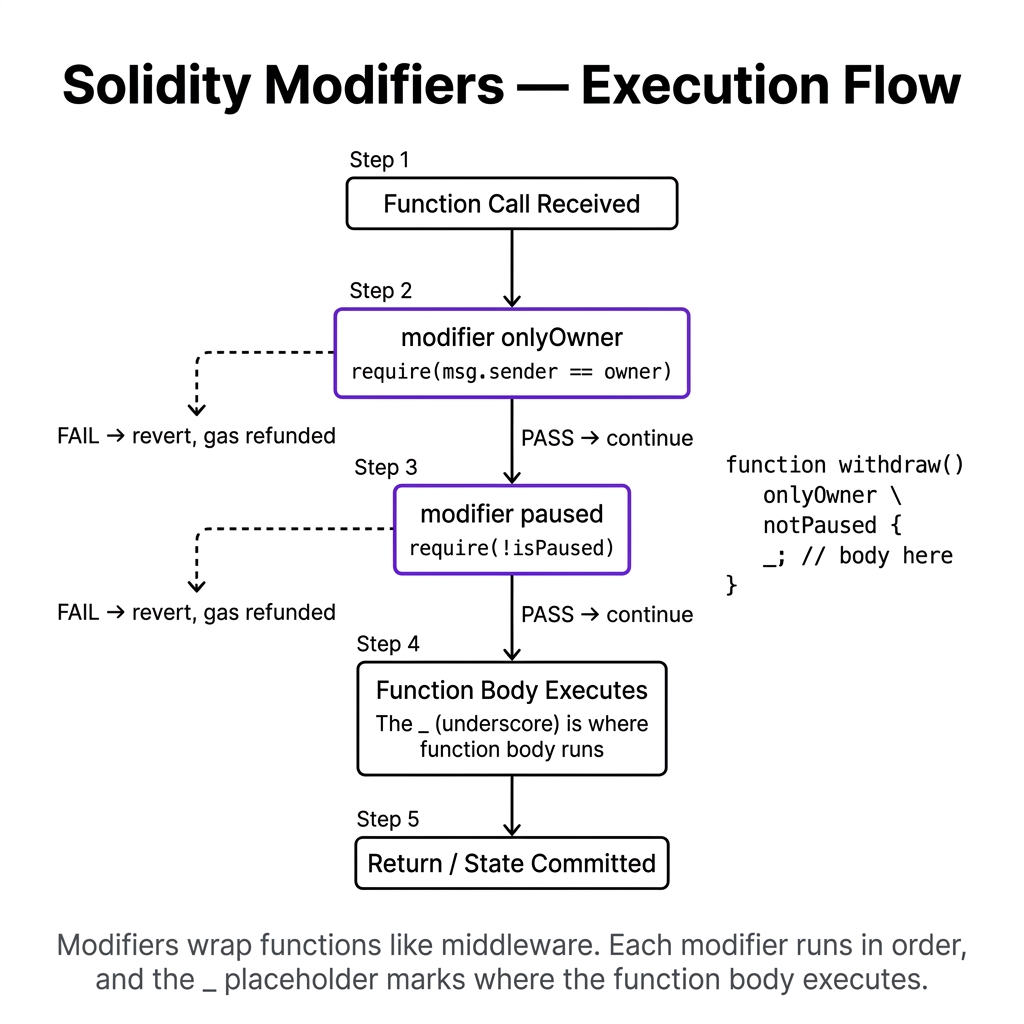
Modifiers can execute checks both before and after your function runs. If you place checks before the _; placeholder, they act as precondition gates. If you place code after the _; placeholder, it executes post-run wrap-ups (like updating internal state metrics or logging executions). However, post-execution modifier states are rarely used and can complicate debugging; keep checks strictly pre-execution!
2. Technical Breakdown: The Turnstile Modifier
Let's look at how modifiers are designed and chained:
- Modifier Chaining: In
buyTokens, the EVM executes the decorators sequentially from left to right:- It runs
whenActive(checks if sale is live). - It releases the first lock and jumps to
costs(verifies value matches price). - It releases the second lock and executes the actual token purchase code.
- It runs
The Reentrancy Modifier Trap: A common security anti-pattern is writing modifier gates that call external contract functions or transfer ETH. Because modifiers hide logic outside the main function body, placing complex external contract calls inside them makes your code highly vulnerable to Reentrancy attacks. Keep your modifiers strictly bound to cheap, read-only local variable validations!
3. Summary of Modifiers vs. Helper Functions
- Modifiers: Best for access checks, state validations (e.g.
whenNotPaused), and parameters checks that apply across multiple functions. They make code readable and dry. - Internal Helper Functions: Best for complex math operations or algorithms. If a verification has complex nested conditions or is only used in a single function, write it inside the function or as an internal helper to save deployment size!
Deploy TokenSale in Remix. Verify that buyTokens fails if the contract price parameters are underpaid. Now call toggleSale to pause the contract, and verify that any subsequent buyTokens calls revert instantly with the SaleNotActive custom error!
Was this lesson helpful?
Let us know what you think of this specification. (submitting anonymously)