
What deployment actually means — validator execution
Bytecode compilation, constructor execution, contract address creation, and validators storing contract state.
Let's address the massive, glowing question every Solidity beginner is afraid to ask:
What does "deploying" a smart contract actually mean?
I had a very traditional Web2 mental model when I first hit that blue "Deploy" button in Remix: I'm uploading my Solidity file to an Ethereum server in the cloud. That server compiles it, spins up an active process, and runs my code inside a virtual daemon.
I expected a server panel, CPU logs, and a RAM monitor. But it doesn't work that way. There is no active server process, there is no file upload, and smart contracts are not running active loops.
1. The Story: Searching for the Ethereum CPU Monitor
When I deployed my first contract, I sat there waiting for the dashboard. I was looking for the Vercel-style deployment screen. I wanted to see the server health graph, CPU utilization, and RAM logs.
Instead, all I got was a 66-character hex hash: 0x89ab...7c3d and a final coordinate.
"Okay," I thought, "where do I go to see if the server is healthy? How do I reboot the machine if it hits an infinite loop? Who pays for the idle CPU time when no one is using the contract?"
This confusion stems from a fundamental misunderstanding of the ledger state machine. A smart contract does not "run" on a server. It sits perfectly dead, chiseled into global memory like coordinates on a public monument.
2. The Metaphor: The Stone Monument in the Gallery
To clear the confusion, let's use a physical analogy (keeping it to exactly 20% of our scope):
If Web2 deployment is like hiring a live employee who sits at a desk and runs a live code loop, Web3 deployment is like sculpting a stone monument and placing it inside a public gallery.
Let's map this transition:
- Sketching the Blueprint: Writing your Solidity code.
- Casting the Iron Mold: Compiling it to Bytecode (the physical shape of the monument) and printing a translation pamphlet (ABI) so visitors who speak different languages (like JavaScript/TypeScript) know how to interact with it.
- Delivering to the Gallery: Packaging the mold into a cargo box with a blank recipient address (a
to: nulltransaction). - Pouring the Concrete: The network's validators receive the cargo box, execute the mold's setup code once (the constructor), pour the cement, peel the mold away, and generate a permanent coordinate (the contract address).
- Reading the Stone: The monument is completely passive. It never runs a loop or monitors webhooks. When users call a function, they walk up to the stone coordinate, read the rules, run the math locally on their own clipboard (local execution), and write down their state update.
3. The Visual Flow: The Deployment Pipeline
Here is the exact structural sequence of code transitions. Our dApp UI represents this pipeline as a sequential, active signal path. As a developer, you should visualize this as an assembly line that turns raw text into a frozen block of ledger state:
[!TIP] FRONTEND INTERACTIVE TRIGGER: Notice how the deployment process is entirely transactional. When your frontend displays a deployment status tracker, it is tracking the progression of this exact pipeline, waiting for the validators to process the constructor execution and return the address. Make sure your SVG nodes highlight sequentially as the transactions propagate.
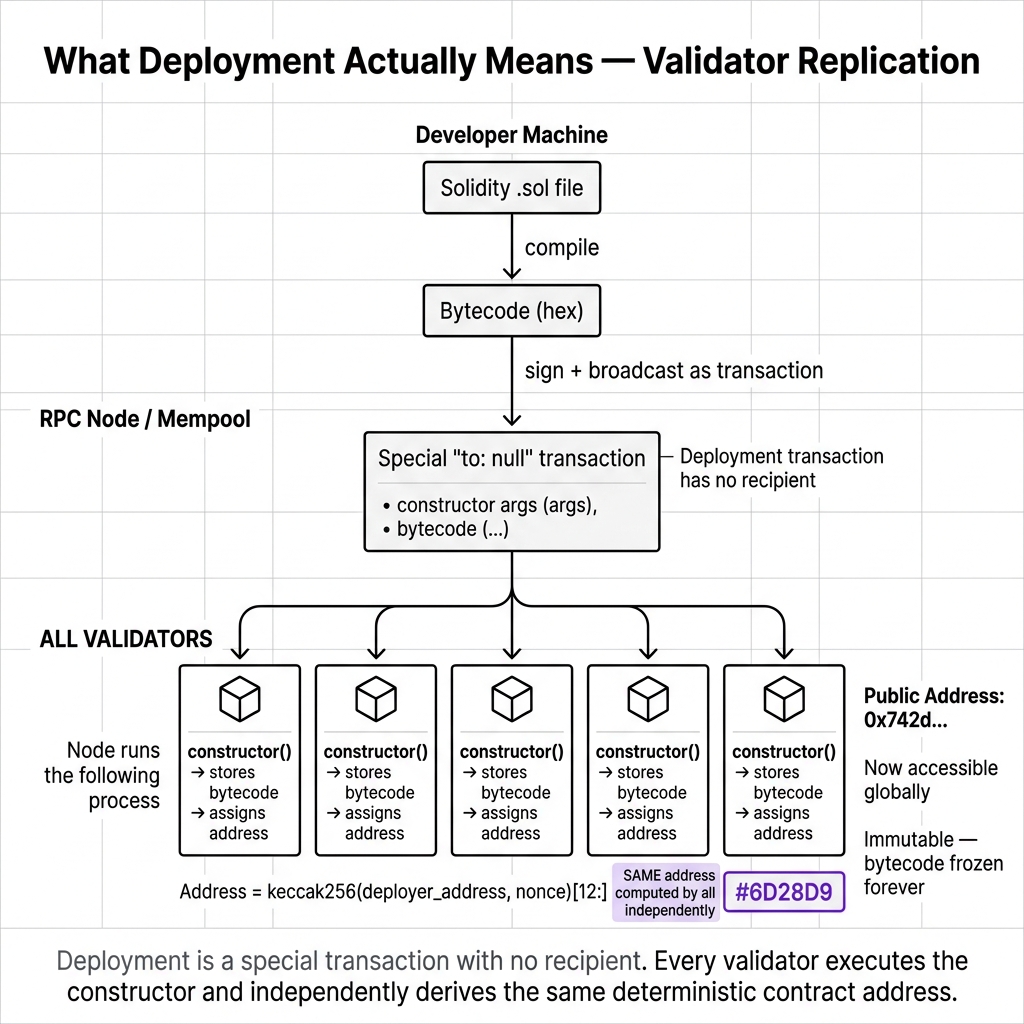
4. Technical Explanation: Bytecode Sandbox & Address Math
Now, let's dive into the technical details (making up 80% of our focus) of how the EVM handles this process under the hood.
1. The Destination-less Container
How does the network know you want to create a new contract instead of sending coins to someone?
The secret lies in the recipient field of your transaction. When you deploy a contract, you sign a transaction where the to field is completely empty (to: null or to: 0x0).
When a validator node pulls this transaction from the mempool and sees that there is no recipient, it shifts gears. It spins up a temporary execution stack, loads the transaction data, and executes the constructor parameters inside a temporary sandbox.
The payload in the data field is your Creation Bytecode (initCode). This contains the logic of your constructor (setup routines) and the raw Runtime Bytecode (the actual logic of your contract).
The Disappearing Constructor: Why is constructor code never stored inside the final contract address? Because the validator runs the constructor instructions inside a temporary sandbox, sets the initial variables, and then peels the constructor code away, writing only the remaining runtime bytecode to the permanent storage state. The constructor is discarded like a wax candle mold.
2. The Deterministic Address Math
When the concrete is poured, the monument's spot in the gallery is not selected at random. The contract address is calculated using strict, deterministic math.
Standard Coordinate Path (CREATE)
By default, the EVM calculates the address using your public account address and your transaction history count (your nonce):
Because your transactions are strictly sequential, your 4th deployment will always generate the exact same coordinate.
- The Nonce Drift Story: I once tried to deploy a contract to the exact same address on both Goerli testnet and Ethereum mainnet. I spent hours synchronizing my deploy transactions. But because I had sent one accidental transfer on Goerli in between, my nonces got out of sync. My contracts ended up at completely different coordinates, breaking our multi-chain frontend configurations!
The Predictable Blueprint (CREATE2)
Advanced developers bypass the nonce entirely, calculating the address based on a custom salt parameter and the bytecode itself:
This is incredibly powerful: it allows you to calculate and know your contract's address before you even broadcast the deployment transaction, letting users deposit funds to a secure, predictable coordinate that has not even been built on-chain yet!
The Nonce Drift Trap: Relying on standard CREATE for multi-chain deployments is a major risk. If a validator on Polygon executes your transaction at nonce 5, but on Arbitrum your transaction goes through at nonce 6, your contract addresses will drift. An attacker can exploit this drift to deploy malicious contracts at your expected coordinates on the secondary chains. Always use CREATE2 for multi-chain consistency!
3. Why We Don't Need an Active CPU
Let's return to the CPU question: "Who pays for the idle CPU time when no one is using the contract?"
The answer is: No one, because idle contracts don't consume CPU.
When a smart contract is idle, it is nothing more than cold bytes stored on thousands of hard drives across the globe. It is passive state. Only when a user sends a transaction calling a contract function does a validator's CPU wake up, execute the opcodes using the user's gas, and update the local database.
The user pays for every single opcode execution. The contract itself is a perpetual motion machine that costs nothing to maintain while waiting for a trigger.
Most production contracts rarely use direct immutable deployments. Teams use proxy patterns for upgrades. Once your runtime bytecode is written to the global ledger state, you cannot modify a single variable type or patch a logic vulnerability. The code is frozen forever.
Deploy a simple contract on Sepolia using Remix. Search the transaction hash on Etherscan. Locate the empty To field and look at the Etherscan contract address creation index. Trace the creation hex bytes to verify the init code.
Was this lesson helpful?
Let us know what you think of this specification. (submitting anonymously)