
What onlyOwner Actually Does
msg.sender checks, owner access privileges, and transferOwnership sequences.
Let's address the classic administrative security prompt that every smart contract developer encounters:
You are deploying a contract and realize: "Wait! If my contract is published on a public blockchain, how do I prevent random strangers from calling my withdraw function and emptying all the funds?"
I genuinely had this panic early on. I expected the blockchain network to automatically know that I was the creator and shield my private functions.
The hard reality is that the EVM is blind to authorship. You must explicitly build authentication gates using public address checks.
The standard way to build this gate is using the onlyOwner modifier, usually imported from OpenZeppelin's Ownable contract.
1. The Metaphor: The Server Room Keycard Scanner
Imagine your smart contract is a physical office building:
- The Lobby (Public Functions): Anyone can walk in off the street, look at the directories, and talk to reception (read public views).
- The Server Room (Protected Functions): Inside the building, there is a locked room with a keycard reader on the wall.
- The Keycard (The Owner Address): When you declare a contract, the deployment transaction stamps your public address as the designated Master Keycard (
ownerstate variable). - The Scan Check (
msg.sender): When anyone attempts to open the server room door:- The scanner checks the unique signature chip on the card currently swiped (
msg.sender). - If the chip coordinates exactly match the master signature key registered on the wall, the lock clicks open.
- If there is a single digit mismatch, the system triggers an alarm, rolls back the transaction immediately (
revert), and locks the door shut.
- The scanner checks the unique signature chip on the card currently swiped (
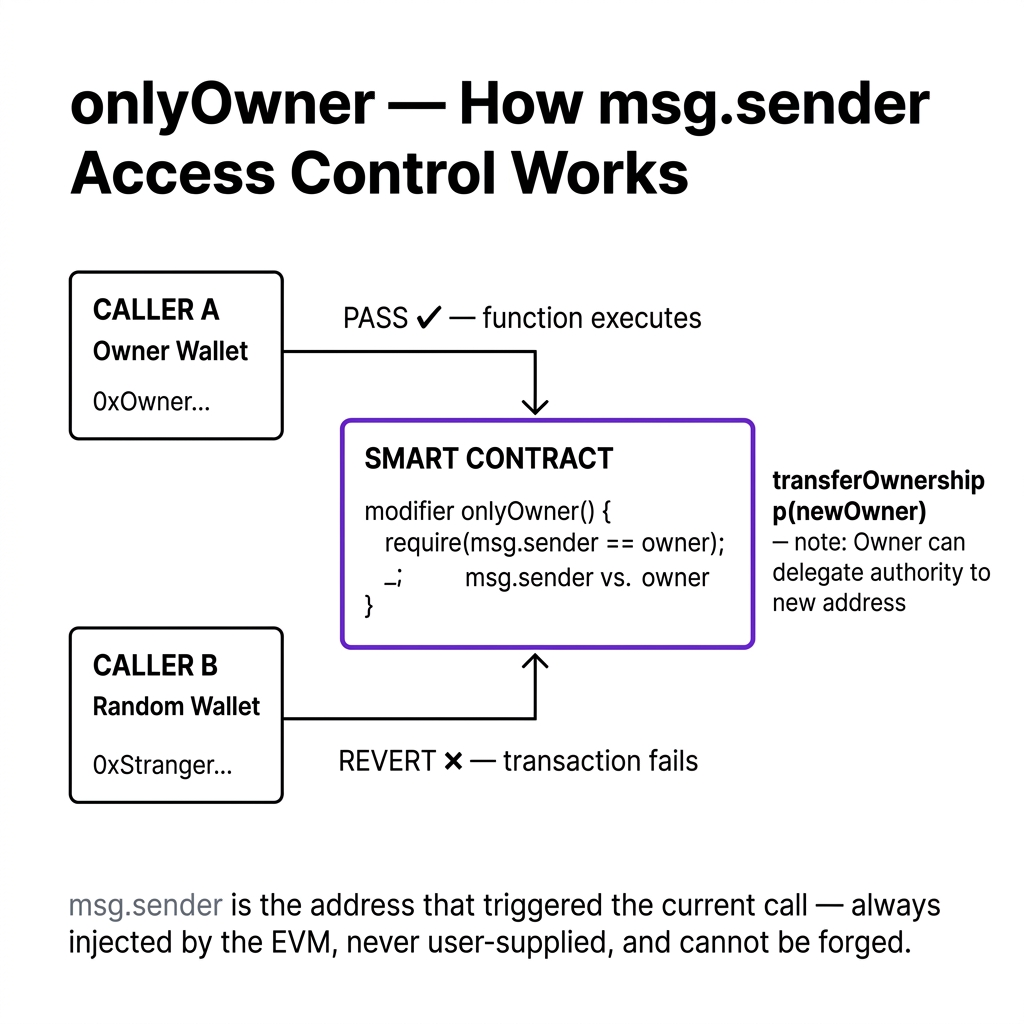
Owner privileges are the number one target for Web3 hackers. If an admin's private key is compromised, or if they accidentally leak their seed phrase, the attacker swiping that master keycard gets total control of your contract instantly. In production systems, you should avoid leaving a single EOA (External Owned Account) address as the owner; use a Multi-Signature Multisig wallet (like Gnosis Safe) instead!
2. Technical Breakdown: Ownable Pattern from First Principles
Let's see how ownership verification is written from scratch in Solidity:
msg.sender: Reflects the direct caller of the function.ownerState Variable: The registered master keycard coordinate written in state.revert NotOwner(): If the checks fail, this exits, rolling back any modifications made during the transaction.
The Zero Address Trap: A common vulnerability is transferring ownership to the 0x000...000 address (the zero address) by mistake (for example, by calling transferOwnership with an empty or uninitialized argument). This permanently locks the contract out of all administrative actions forever. Always add a safety requirement verifying newOwner != address(0)!
3. Summary of Ownership Execution
When you call withdraw():
- The EVM loads your address as
msg.sender. - The EVM loads
ownerfrom state. - The comparison
msg.sender == ownerexecutes. - If true, the code jumps to the actual payout operations. If false, it reverts.
Deploy the SimpleVault in Remix. Verify that the deployer address can call withdraw(). Now switch the active account in Remix to a different address and attempt to call withdraw()—inspect the console error and verify that the transaction reverts with the NotOwner custom error.
Was this lesson helpful?
Let us know what you think of this specification. (submitting anonymously)