
Blockchain is NOT your database — hybrid design rules
Crucial system design architectures: ProofChain, Firebase caching, IPFS hashing, event indexing, and resolving query issues.
Let's begin with the ultimate Solidity developer trap:
Assuming that because you can store a variable in a contract, you should.
When I designed my first Web3 dApp, I treated my smart contract like a standard PostgreSQL database. I thought: Awesome! I'll store the user's profile pictures, their bios, their full blog posts, and their string usernames directly inside a Solidity struct! Everything is decentralized, safe, and immutable!
My app worked beautifully in local Hardhat testing. But when I tried to deploy it on a live network under real load, my transactions started reverting, gas fees went vertical, and my users abandoned the platform.
1. The Confusion: The $500 Profile Picture
In Web2, storing a 10KB string in a database costs a tiny fraction of a cent. If you use PostgreSQL or MongoDB, you don't even think about the byte size of a username.
So when I tried to upload a simple 10KB profile image avatar into my contract state, I was expecting a fraction of a penny in fees.
Instead, my MetaMask popup showed a transaction fee of over 0.25 ETH (about $500 at the time).
"Wait, what?" I muttered. "Did I write an infinite loop? Is the gas price spiking?"
No. The gas price was normal. I had simply hit the physics engine of decentralized storage. Every single byte chiseled into contract state must be copied and stored on tens of thousands of active validator nodes worldwide forever. You aren't renting a small hard drive; you are buying a permanent spot in global consensus memory.
2. The Metaphor: The Safe Deposit Box
Imagine you run a logistics company and want to record your cargo manifest.
If you try to store all your actual heavy cardboard shipping boxes, the delivery trucks, and giant employee paper records inside a bank safe deposit box (the Blockchain):
- You will run out of space in seconds.
- The vault storage fees will bankrupt you.
- To check if a specific package is loaded, you have to drive to the bank, open the box, and manually shuffle through physical papers.
Instead, the correct hybrid architecture is:
- You keep the heavy cargo boxes in your off-site warehouse (IPFS).
- You write the shipping logs, employee profiles, and routing tables on your office computer (Firebase/PostgreSQL) for fast search.
- You take the cryptographic seal hash (SHA-256 fingerprint) of the shipping manifest, print it on a tiny slip of paper, and put only that slip of paper inside the bank safe deposit box (the Blockchain).
If anyone tries to tamper with the cargo in your warehouse or change the logs on your office computer, the signature hashes won't match the slip of paper in the bank vault. You get 100% security at virtually zero cost.
"Fully decentralized" does not mean storing everything on-chain. Storing strings, descriptions, or heavy structs in Solidity is a production anti-pattern. If a state does not require mathematical consensus, double-spend protection, or absolute validation rules, it does not belong in a smart contract.
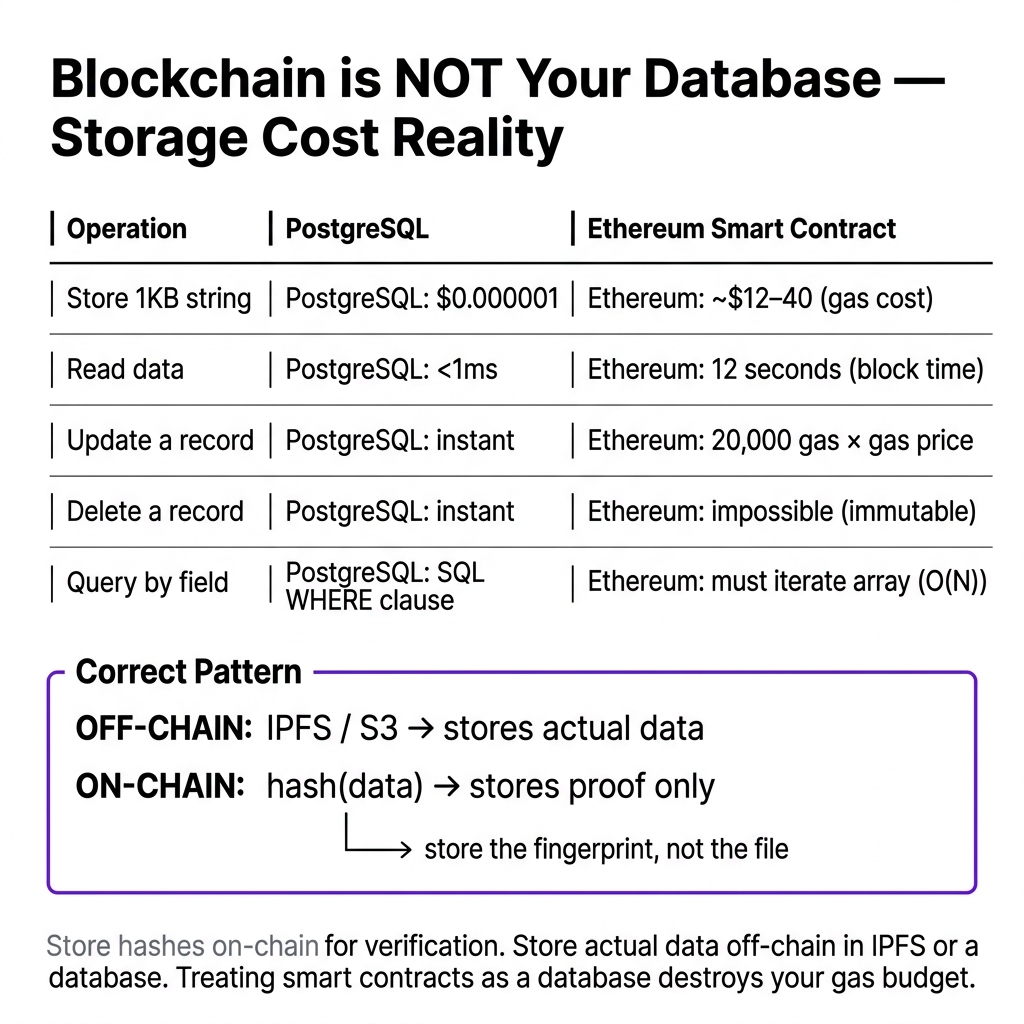
3. Technical Explanation: The Cost of an SSTORE
To understand why on-chain storage is so expensive, we have to look at how the EVM charges gas for writes.
In the EVM, the opcode used to write to state is called SSTORE (Store State).
- Storage Slot System: The EVM allocates storage in 32-byte chunks (slots).
- The SSTORE Toll:
- Writing a value to a storage slot for the first time (changing a slot from
0to a non-zero value) costs 20,000 gas. - Modifying an existing storage slot costs 5,000 gas.
- Storing a 256-bit integer (like a token balance) fits in one slot (20,000 gas).
- Storing a long string (like a username or blog post) requires multiple dynamic slots, costing 20,000 gas for every 32 bytes of text!
- Writing a value to a storage slot for the first time (changing a slot from
If you store a 1,000-character bio:
At a modest 50 gwei gas price, that single string write costs over $25. If the network gets congested, it scales to hundreds of dollars.
The Dynamic Array Ticking Time Bomb: A common beginner pattern is trying to filter and query state inside a smart contract using a dynamic array. Developers write a function that loops over all items to find ones matching a criteria. Since Solidity does not have database indexes, this loop is an O(N) operation. Under real load, the array grows, the loop gas cost climbs, and eventually, the transaction hits the Block Gas Limit—rendering critical functions practically unusable due to gas costs!
4. Technical Explanation: The Hash Proof Solution
How do we build a secure system if we can't write our data to the blockchain?
We use cryptographic hashing.
A hash function (like SHA-256 or Keccak-256) takes an input of any size (a 10KB profile image, a 10MB PDF, or a 1GB video) and compresses it into a fixed 32-byte hex fingerprint:
Instead of sending the heavy file to your contract, you write a hybrid workflow:
By hashing the file inside the browser before sending the transaction, your transaction payload remains exactly 32 bytes. The gas fee is cheap, flat, and completely predictable.
If anyone modifies a single pixel of the PDF on IPFS, their hash will change, immediately violating the immutable proof chiseled on-chain!
The Query Fallacy: Do not design your Solidity contracts to support rich search queries. You cannot easily run sorting, search, or filtering logic inside Solidity without exhausting gas. Instead, emit Solidity Events whenever state changes, and use an off-chain indexing service like The Graph to compile those events into a searchable GraphQL database.
5. The Reality: The Off-Chain Sync
In production, your dApp's frontend should almost never read descriptive state directly from an Ethereum RPC node.
Reading raw state directly from the chain to populate a UI:
- Causes high latency (waiting seconds for RPC node roundtrips).
- Rate-limits your servers.
- Fails when filters or pagination are required.
The reality is that 95% of Web3 production dApps read from an off-chain SQL cache or indexing subgraph, fallback-checking the blockchain directly only when validating cryptographic proofs or signing transactions.
Your smart contract is not a database. It is a secure, decentralized referee that validates the state, leaving the heavy lifting of storage and indexing to the off-chain stack.
Analyze an NFT project like Bored Ape Yacht Club. Look at its smart contract on Etherscan. Does it store the actual ape image bytes on-chain? Search for the tokenURI(uint256) function and identify what kind of URL format it returns.
Was this lesson helpful?
Let us know what you think of this specification. (submitting anonymously)