
Cache invalidation in Web3 — when does truth change?
Immutable content-addressed caching vs mutable on-chain state. TTL-based vs event-driven invalidation. The hybrid cache strategy for a voting dApp.
There are two hard problems in computer science, as the saying goes: cache invalidation and naming things.
In Web3, cache invalidation has a fascinating property that makes it both simpler and trickier than traditional web apps.
Simpler: IPFS content is immutable. A CID never changes. Cached content is always correct — the cache only becomes stale when a new CID is referenced.
Trickier: on-chain state is mutable but unpredictably updated. Vote counts change on every vote transaction. Voting status changes when startVoting() or endVoting() is called. Your cache of "current vote count" becomes stale the moment any voter submits a transaction.
Getting cache invalidation wrong in Web3 means users see incorrect data — often in high-stakes situations like election results.
1. The Two Cache Types in a Web3 dApp
2. The Story: The Wrong Vote Count Display
After adding Redis to ChainElect, I made a mistake in the results page:
During a live voting session, the results page was showing vote counts from up to 1 hour ago. A candidate who had received 50 new votes in the last 30 minutes was still showing their old count. During an election — even a demo one — this is unacceptable.
The fix: invalidate the vote count cache on every Voted event, using the event subscription from Module M2.2:
3. The Visual: TTL vs Event-Driven Invalidation
[!TIP] VISUAL TRIGGER FOR FRONTEND: Animate a timeline with two parallel tracks. Track A (TTL) shows a long period of serving stale data after a state change. Track B (Event-driven) shows an immediate invalidation the instant the event fires. Make the difference stark and visible — this is the intuition that explains why event subscriptions matter.
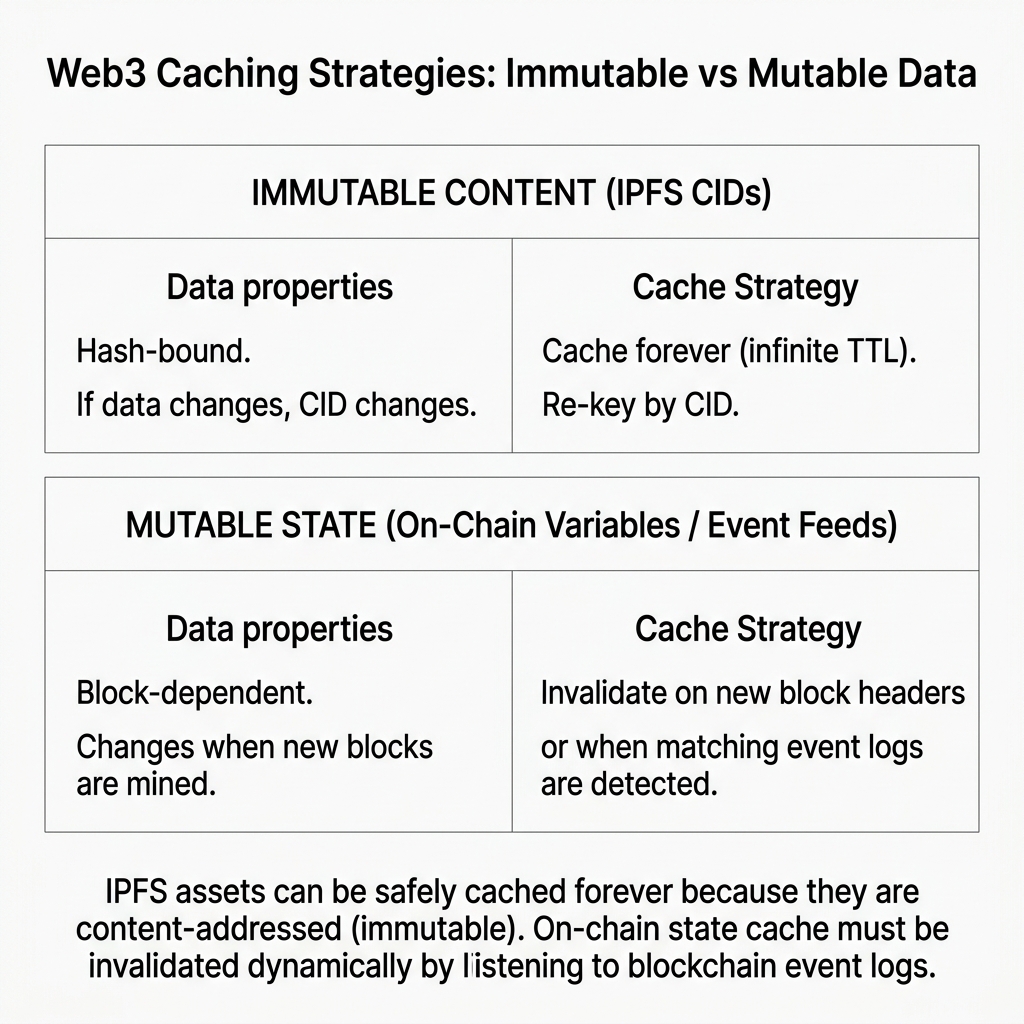
4. The Hybrid Cache Strategy
The correct strategy in ChainElect matches each data type to its cache behavior:
| Data Type | Source of Truth | Cache TTL | Invalidation Trigger |
|---|---|---|---|
| Voter profile images | IPFS (immutable) | 30 days | Never (CID changes = new key) |
| Candidate vote counts | Contract state | 10 seconds max | Voted event |
| Voting status (active/ended) | Contract state | 5 seconds max | VotingStarted / VotingEnded events |
| Remaining voting time | votingEndTime | 0 (compute live) | N/A (computed from timestamp) |
| Voter registration status | Contract mapping | 60 seconds | VoterRegistered event |
Remaining voting time (getRemainingTime()) should never be cached — it's a timestamp computation that changes every second. Cache it even for 5 seconds and the timer on the UI will visibly freeze.
Cache invalidation in high-stakes applications (governance votes, token distributions) has real financial consequences. If your results page shows stale vote tallies during an on-chain election, decisions might be made on incorrect data. In production governance systems, the UI typically reads directly from the subgraph (Module M2.5) rather than maintaining a local cache — the subgraph is itself a cache that's updated on every indexed event.
The "Cache Everything" Over-Engineering Trap: After discovering Redis, many developers start caching everything with aggressive TTLs. This creates a system where user actions appear to have no effect (they vote, count doesn't change, confusion ensues). Before adding caching to any data type, ask: "How stale is acceptable?" For immutable IPFS content: infinitely stale is fine. For live vote counts: even 10 seconds stale may be too long.
Look at ChainElect's contract — getRemainingTime() returns how many seconds until voting ends. Should this value ever be cached? Now consider: candidatesCount — a number that increases each time a candidate is added but never decreases during an election. What cache TTL would be appropriate for this value? What event should trigger its invalidation?
Was this lesson helpful?
Let us know what you think of this specification. (submitting anonymously)