
Actor modeling — who does what
Permissions, trust models, and multi-signature bounds.
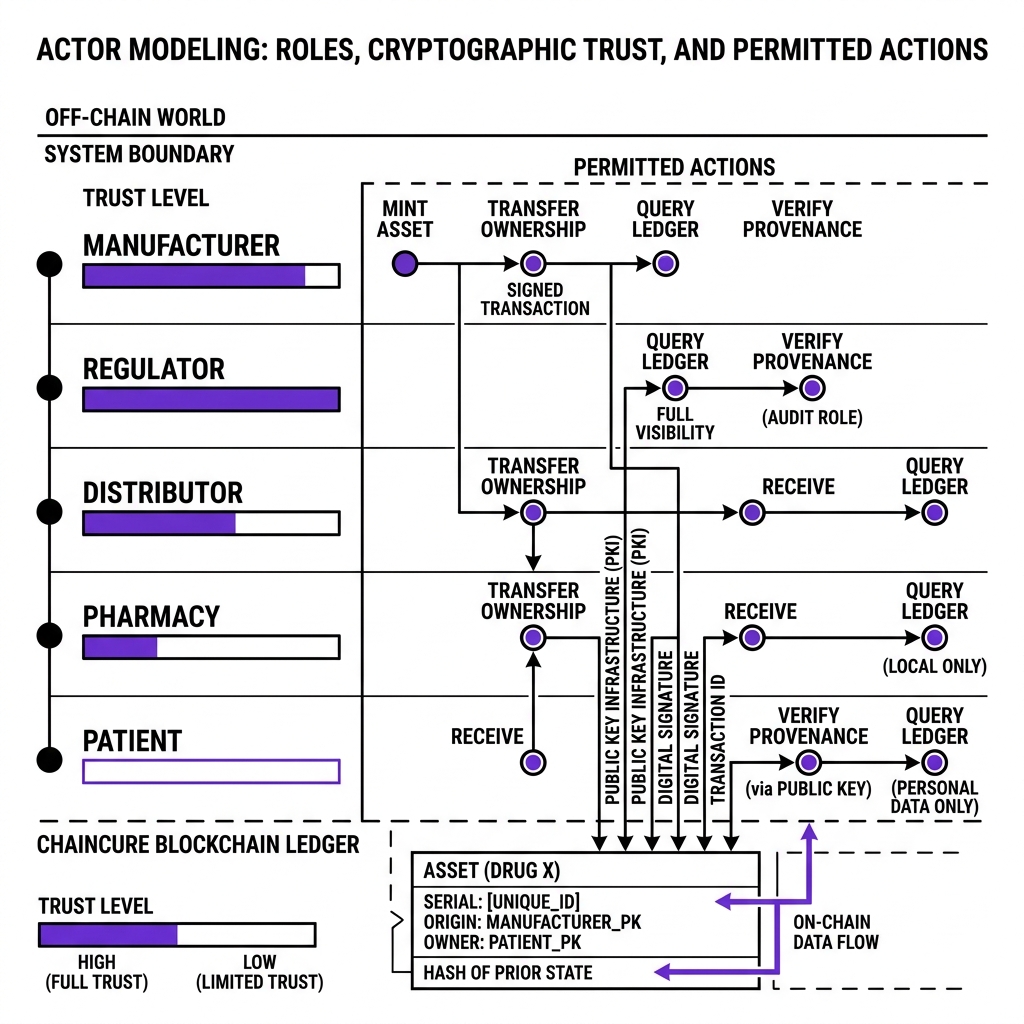
Before I wrote a single line of Solidity for ChainCure — a pharmaceutical supply chain system where fake drugs kill people — I had to answer one question first:
Who is actually allowed to do what?
Not in a hand-wavy, "the admin manages things" way. Precisely. Cryptographically. At the function selector level.
That process is called actor modeling, and it is the first thing I do on every system design now.
1. What Is an Actor?
An actor is any entity that interacts with your system and has a distinct permission set.
Actors are not users. A single human can play multiple actor roles depending on context. An actor is a role with a trust level, not a person.
In a traditional Web2 system, you enforce this with JWT claims and database row-level security.
In a smart contract system, you enforce this with msg.sender checks, modifier decorators, and AccessControl role registries — permanently, immutably, and publicly verifiable.
2. The ChainCure 5-Actor Model
ChainCure tracks pharmaceutical drugs from manufacturer to patient. A counterfeit tablet costs lives. The trust model must be precise.
Here is the full actor map I designed before writing a single contract:
Notice what the Patient actor can do: one thing. Read-only verification. No write access. The QR code on the drug box points to a public verifyAuthenticity() call — the patient never even knows they're reading from a blockchain.
3. Trust Levels → Solidity Patterns
Each trust level maps directly to a Solidity implementation pattern:
Highest trust (Manufacturer): Assigned during contract deployment. Cannot be transferred to an arbitrary address. Uses OpenZeppelin Ownable or a custom MANUFACTURER_ROLE.
Medium trust (Pharmacy): Dynamic — pharmacies are registered after deployment. Uses AccessControl with a role registry.
Lowest trust (Public): No role check needed. Any address can verify. These are view functions — they cost no gas to call.
4. Multi-Signature Bounds
Some actions are too critical for a single actor to authorize alone.
In ChainCure, flagging a drug as counterfeit has severe consequences — it triggers a recall. A single compromised regulator wallet cannot be allowed to halt an entire supply chain.
This is where multi-signature bounds come in:
Implementation: off-chain signatures collected, verified on-chain via ECDSA.recover() before state change executes.
5. The Actor Modeling Process
For any new system you design, follow this sequence before writing code:
Step 1 — List every human or system that touches your product. Don't think in roles yet. Think in real people. A warehouse manager. A hospital procurement officer. A government inspector.
Step 2 — Cluster them by trust. Who can create records? Who can read? Who can destroy? Draw clear lines.
Step 3 — Map each cluster to a Solidity pattern.
Highest trust → constructor assignment. Dynamic trust → AccessControl. Public trust → view functions.
Step 4 — Identify multi-party thresholds. For every irreversible action, ask: can a single compromised key cause catastrophic damage? If yes → require multi-sig.
Step 5 — Write the actor map before opening Remix. If you cannot fill in the table above for your system, you are not ready to write contracts.
The most common smart contract architecture mistake I see is "admin does everything." One owner address with full control is a single point of failure — and a single point of compromise. Actor modeling forces you to distribute trust before you code it in.
Map the actors for a decentralized voting system. Who registers candidates? Who casts votes? Who tallies results? Who can pause the election? For each actor, specify: (1) their trust level, (2) which Solidity access pattern applies, and (3) whether any action requires multi-party sign-off.
Was this lesson helpful?
Let us know what you think of this specification. (submitting anonymously)