
ChainElect autopsy — gas limits and storage bottlenecks
A postmortem on ChainElect: how a naive smart contract architecture hit the Block Gas Limit, how on-chain storage traversals fail, and how to pack slots for efficiency.
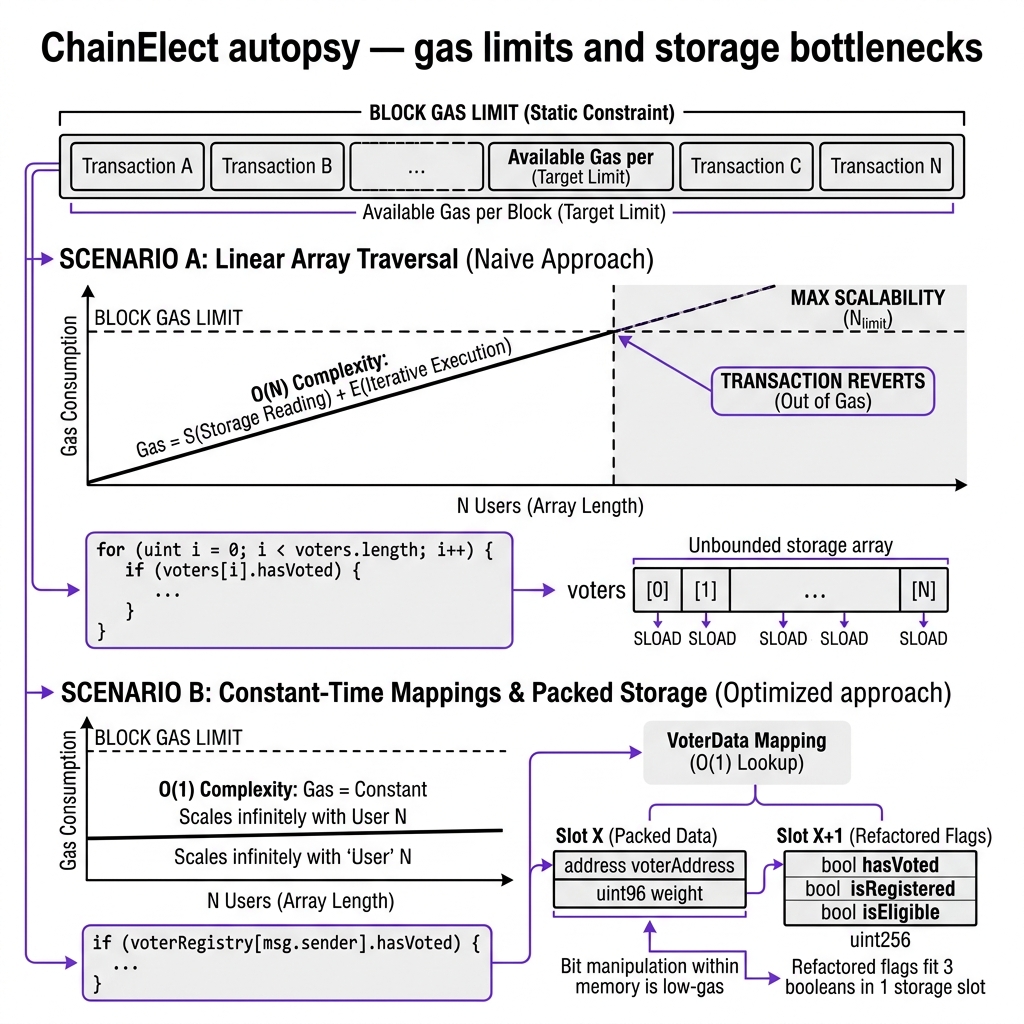
I was sitting in my bedroom, checking the live dashboard of my first real-world deployment: ChainElect, a decentralized voting contract designed for a university student body election. Everything was working perfectly for the first 50 votes.
Then, at 200 votes, the frontend began to lag.
At 400 votes, the "View Leaderboard" button took 8 seconds to load.
At 700 votes, the entire voting process froze. Every transaction submitted by a student reverted with an obscure error: Out of Gas.
We had to halt the election.
This postmortem analyzes the exact structural flaws of the first version of ChainElect, how on-chain storage traversals hit the Ethereum virtual machine's physical limits, and the exact design patterns required to build gas-resilient state layers.
1. The Naive Design
In the initial design of ChainElect, I treated Solidity storage like a relational database. I wanted to check if a user had voted and display the list of all candidates dynamically.
Here was the structural layout of the naive contract:
2. The Clinical Failure: The Block Gas Limit
Every block on Ethereum or Polygon has a Block Gas Limit (e.g., 30 million gas on Ethereum). This is the maximum cumulative amount of computational gas that can be spent within a single block.
When a transaction exceeds this limit, the EVM terminates execution and reverts all changes, but still charges the sender for the gas consumed up to that point.
Our contract hit two separate gas ceilings:
1. The Dynamic Loop Gas Trap
The countVotes() function executed an $O(N)$ loop over the voters array. When called from a read function (view), it was free. But we also called it inside the state-changing vote() function to check quorum thresholds:
As the voters array grew:
- At 50 voters: loop consumed 45,000 gas.
- At 400 voters: loop consumed 360,000 gas.
- At 700 voters: loop exceeded the transaction gas limit, causing every call to
vote()to revert.
2. On-Chain String Storage
Storing string voterName inside the struct was a disaster. In Solidity, strings are dynamic arrays of bytes. Storing a string requires writing data across multiple 32-byte storage slots. Writing to a cold storage slot (using the SSTORE opcode) costs 20,000 gas.
Storing 30-character voter names cost more than the entire voting logic combined.
3. The Remediated Architecture
To solve these scaling failures, we decoupled reads from writes and restructured our storage:
- O(1) Access Mappings: We replaced the dynamic array search with a mapping and a single state variable tracker:
SmartAccount.solsolidity
- Metadata Offshoring: We moved the voter's name off-chain (IPFS) and stored only the 32-byte content hash reference or validated the user session via an API proxy layer.
- Storage Slot Packing: We arranged state variables sequentially to pack multiple variables into a single 32-byte slot:
SmartAccount.solsolidity
The View Loop Illusion:
It is a common mistake to think: "If a function is marked view, its gas cost doesn't matter." While true for standard client reads, if a view function is called by a state-changing transaction (e.g. inside another contract or as a requirement check), the gas cost of the view loop is fully added to the transaction execution cost. Never put $O(N)$ dynamic loops inside checking logic.
4. Live From the Repo: The Real ChainElect
Here's ChainElect's actual README — the project where all these gas failures happened. You can trace every optimization we discussed back to the real codebase:
Take a look at your current smart contracts. Search for any for loops that iterate over dynamic arrays. Rewrite the contract using a mapping or state counter to eliminate the loop entirely. Calculate the gas savings using a mock test deployment.
Was this lesson helpful?
Let us know what you think of this specification. (submitting anonymously)