
Centralized vs decentralized systems
Single point of failure. Censorship. Downtime. Why decentralization solves specific problems.
We've established that banks and central entities exist to solve the double-spend problem and act as coordinators of trust. But when we build systems on top of these central coordinators, we inherit all their architectural vulnerabilities: single points of failure, censorship, arbitrary database updates, and server downtime.
Decentralization is the architecture of distributing control, data, and power across a P2P network so that no single node can dictate the state of the system.
1. The Single Point of Failure (SPOF)
In traditional systems design, a Single Point of Failure (SPOF) is any component whose failure crashes the entire system.
In a centralized system, the server room or database cluster is the ultimate SPOF. If Facebook's BGP routing configuration breaks, the entire network goes dark for 6 hours globally. If Amazon Web Services (AWS) US-East-1 region experiences a power outage, half the internet stops working.
Decentralized architectures don't have a center. Every node on the network is a server, validator, and database. If 500 Ethereum nodes crash, the remaining thousands keep validating blocks, processing transactions, and serving network requests without a single millisecond of downtime.
2. Layman Explanation: The Town Crier vs The Town Board
Imagine a medieval town where the king appoints a single Town Crier to announce all tax payments, land transfers, and laws.
- If the Town Crier gets sick, no laws are announced.
- If the Town Crier takes a bribe, he can announce that Bob owns Charlie's house.
- If the Town Crier doesn't like Bob, he can refuse to announce Bob's transactions, effectively locking Bob out of the economy.
Now, imagine the town replaces the Crier with a Town Board. Every citizen carries a chisel and a stone tablet. Every time a transaction occurs, the buyer and seller carve it onto a giant public board in the center of the town, and everyone copies the line onto their own stone tablets at home.
- If one citizen goes on holiday, the town board keeps working.
- If one citizen tries to change his tablet at home to claim he owns Charlie's house, he will be laughed out of town because his tablet doesn't match anyone else's.
- No single person can censor Bob because Bob can carve his transaction on the public board for everyone to copy.
3. Technical Explanation: Topology and the Security Boundary
Architectures are defined by their network topologies:
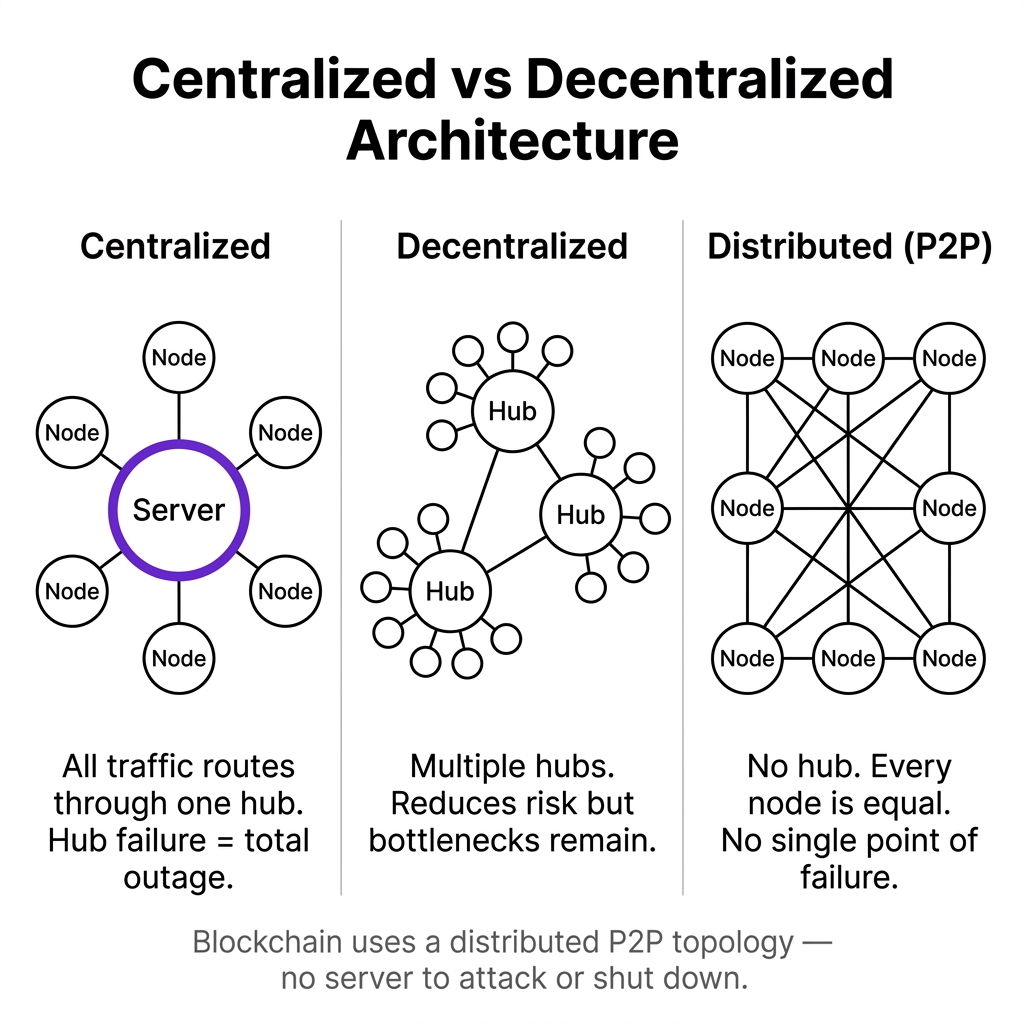
- Centralized: All nodes connect to a single hub. If the hub is compromised or offline, all nodes lose connection. The security boundary is the firewall of the hub.
- Decentralized: Multiple hubs coordinate clusters of nodes. This provides more resilience but still leaves major central bottlenecks.
- Distributed / Peer-to-Peer (P2P): Every node connects directly to multiple other nodes. There are no hubs. If any link or node breaks, messages route around them.
In a P2P blockchain network:
- Gossip Protocol: Transactions travel using a gossip protocol. When you submit a transaction, your wallet sends it to three peer nodes. Those nodes verify it and gossip it to their peers, propagating it across the globe in seconds.
- Data Replication: Every full node keeps a complete, independent copy of the state database. There is no master server to sync from.
- Sybil Resistance: To prevent an attacker from creating 10,000 fake nodes to overwrite consensus, P2P networks use Proof of Work (PoW) or Proof of Stake (PoS). Creating nodes is cheap; acquiring mining hardware or staking capital is extremely expensive.
Centralized
Distributed
4. What Decentralization Solves (and What it Costs)
Decentralization is not a magic wand; it is a fundamental architectural trade-off:
| Benefit | How Blockchain Solves It | The Engineering Cost |
|---|---|---|
| Censorship Resistance | No central authority can block a transaction if it has a valid signature and pays gas. | High Latency: Every node must validate every transaction. It takes seconds/minutes to settle, not milliseconds. |
| High Availability | 100% uptime. The network runs as long as at least one node is online. | Redundancy Overhead: Storing the same transaction on 10,000+ disks is incredibly wasteful and expensive. |
| Immutable History | Transactions chiseled on-chain cannot be reversed without reorganizing consensus. | Irreversibility: If you lose your keys or send funds to the wrong address, there is no support desk to restore it. |
Decentralization is a terrible choice for systems that require high-throughput data processing, like video streaming, gaming databases, or messaging feeds. You should only pay the speed and cost penalty of decentralization when censorship resistance or trustless auditability are your primary design goals.
Suppose you are building a ridesharing app like Uber. Sketch the differences between a centralized server architecture (handling matchmaking, payments, and mapping) and a decentralized P2P version. Which parts are easier to build centrally, and what fails if the central server goes down?
Visual Blockchain Simulator
In the Visual Blockchain Simulator project, you will build an interactive node propagation visualizer. You will animate how a transaction gossips across a P2P network of nodes and how they independently compile it into blocks, visualizing decentralized topology in real time.
- Node propagation
- P2P communication
- Block formation
- Gas fee mechanics
Was this lesson helpful?
Let us know what you think of this specification. (submitting anonymously)