
Consensus — how strangers agree
Byzantine fault tolerance for humans. Why miners/validators exist. The economic incentive design.
How do thousands of independent computers around the globe — run by people who don't know each other, don't trust each other, and have different incentives — agree on a single database state?
This is not just a computer programming problem. It is a fundamental coordination problem known in computer science as the Byzantine Generals Problem.
Let's look at how consensus algorithms solve this coordination challenge.
1. The Core Problem: The Byzantine Generals Problem
Imagine a group of Byzantine generals surrounding an enemy city. They can only communicate via messengers.
- If all generals attack at the same time, they win.
- If only some attack and others retreat, they fail.
- However, some generals might be traitors, trying to coordinate a failed attack.
- Even honest messengers can be captured or killed on the way.
How do the honest generals coordinate a single plan of action when they cannot trust the messengers or each other?
In computer networks, "generals" are nodes, and "traitors" are compromised or malicious nodes sending fake messages (like fake transactions or blocks). Byzantine Fault Tolerance (BFT) is the ability of a network to reach consensus even if some nodes are cheating or offline.
2. Layman Explanation: The Distributed Pub Quiz
Imagine a group of 100 students participating in a trivia quiz, but they are all in separate rooms and can only send written notes to each other. There is no quiz master.
If the question is: "In what year was Bitcoin launched?", different rooms might write different answers. One room might try to cheat and shout the wrong year to confuse the others.
To coordinate, they agree on a rule: Every time a question is asked, they must work on a difficult crossword puzzle. The first room to solve it gets to write down their trivia answer. They slide their solution and answer under the doors of other rooms.
The other rooms check the crossword (which takes a second). If it's correct and the trivia answer is valid, they copy the trivia answer down and start working on the next crossword.
Because solving the crossword requires real work (crossword-solving speed is like computing power), a single student cannot fake answers easily. Even if a few students are traitors, they cannot solve crosswords fast enough to outpace the collective honest students in the other rooms.
3. Technical Explanation: The Mechanics of Consensus
A blockchain consensus algorithm must solve two key issues:
- State Agreement: Deciding which block of transactions is the official next link in the chain.
- Double-Spend Prevention: Ensuring that if Alice tries to send $10 to Bob and Charlie simultaneously, only one transaction is chiseled into the official state.
In blockchain systems, this is solved by combining Sybil Resistance and Chain Selection:
Sybil Protection: The Stake or Work requirement
Nodes cannot participate simply by creating an IP address (which is cheap). They must prove:
- Proof of Work (PoW): Controlling mining hardware (real-world computational power).
- Proof of Stake (PoS): Locking up native tokens (real-world capital).
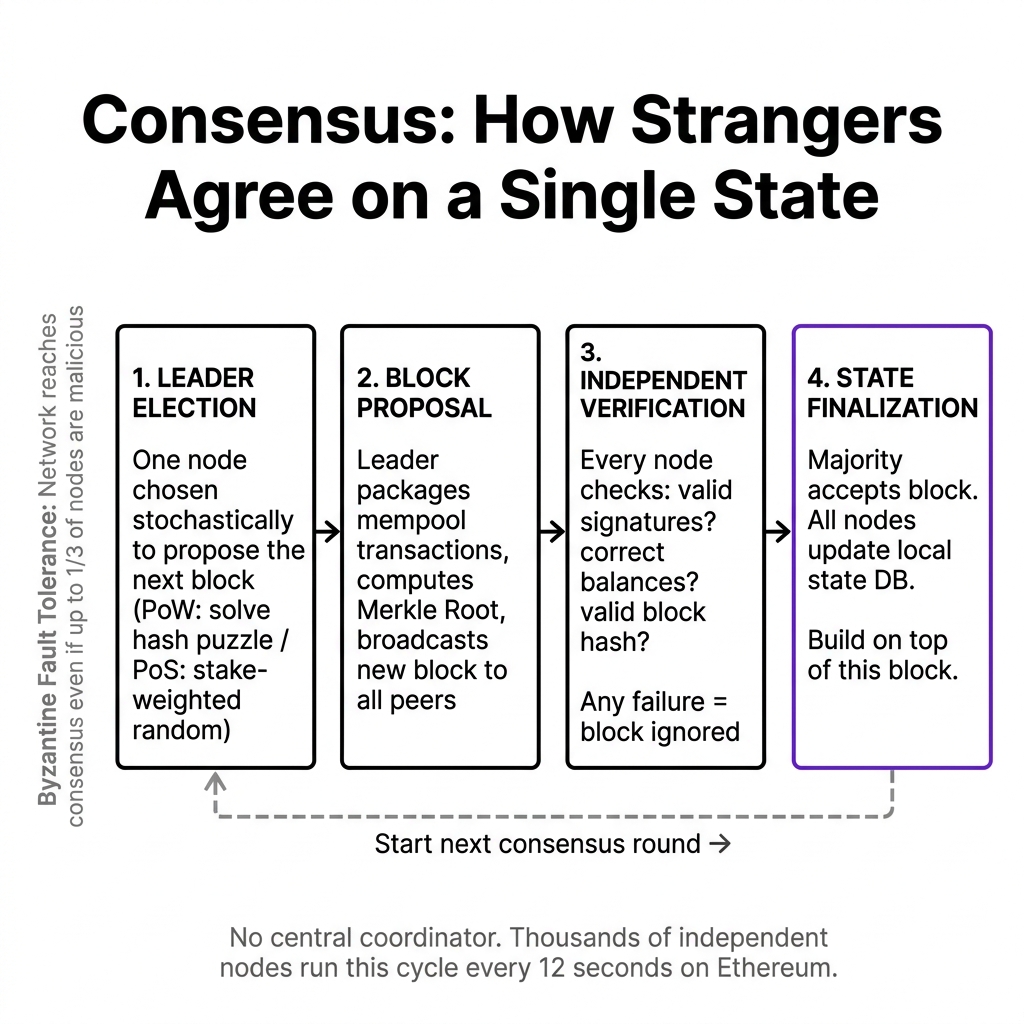
Consensus Progression
Every block cycle:
- Leader Election: A node is chosen (stochastically or via puzzle solving) to propose the next block.
- Block Proposal: The leader packages mempool transactions, computes the Merkle Root, and broadcasts the new block.
- Independent Verification: Every node validates the signatures, block parameters, and transaction balances. If any transaction is invalid, the block is ignored.
- State Finalization: Once nodes accept the block, they update their state database and build the next block on top of it.
// Consensus protocols ensure all nodes independently validate blocks and follow the longest chain to prevent double-spending without a central coordinator.
If a network has 100 validator nodes, and 30 of them go offline due to a global internet routing issue, can the remaining 70 nodes continue finalizing blocks? What ratio of honest nodes is typically required to survive a Byzantine fault?
Visual Blockchain Simulator
In the Visual Blockchain Simulator, we build a consensus propagation simulator. You will write the animation logic that shows a new block travelling from a validator node to other nodes, demonstrating how they verify the block hashes and update their local heights to match.
- Node propagation
- P2P communication
- Block formation
- Gas fee mechanics
Was this lesson helpful?
Let us know what you think of this specification. (submitting anonymously)