
PoW vs PoS — why Ethereum switched
Energy cost of mining. Proof of Stake economics. Validators, slashing, finality.
In September 2022, Ethereum executed one of the most complex software upgrades in history: The Merge.
The network completely swapped its consensus engine from Proof of Work (PoW) to Proof of Stake (PoS) while processing billions of dollars in live transactions, without a single millisecond of downtime.
What is the difference between these two consensus mechanisms, and why did Ethereum make the switch?
1. Proof of Work (PoW): The Computational Arms Race
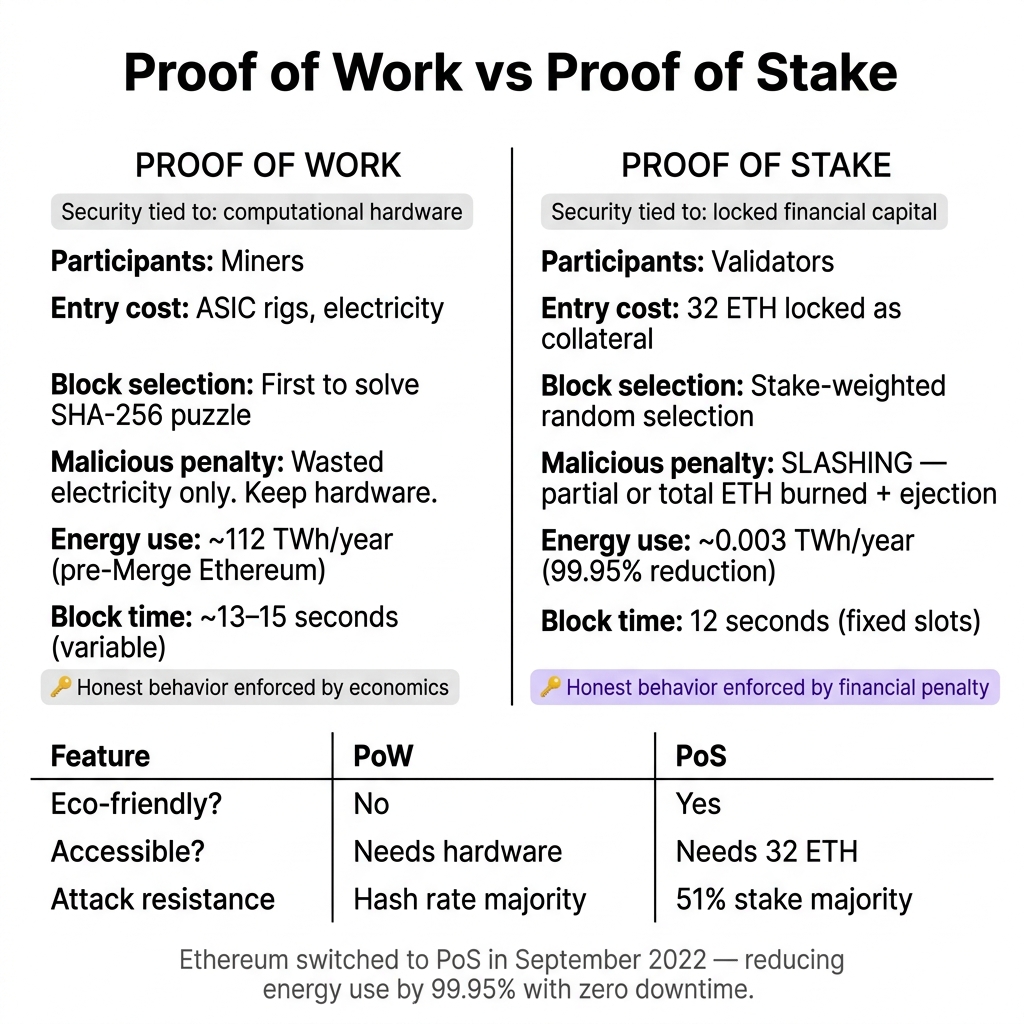
In Proof of Work, the security of the network is tied to computational hardware.
- Nodes (miners) compete to solve a hashing puzzle.
- The probability of mining a block is proportional to your hash rate (how many calculations your hardware can run per second).
- The incentive is earning newly minted block rewards and transaction fees.
The Problem: Energy and Hardware Centralization
Because mining is a winner-take-all lottery, miners pool their resources and build massive industrial warehouses filled with specialized ASIC mining computers.
- Environmental Impact: PoW mining consumes massive amounts of electricity. At its peak, Ethereum mining consumed as much energy as a small country.
- Centralization Risk: ASICs are expensive and hard to manufacture. A few massive mining pools located in regions with cheap electricity controlled the majority of the network's hashing power.
2. Proof of Stake (PoS): The Financial Security Model
In Proof of Stake, the security of the network is tied to financial capital.
- There are no miners. Instead, we have Validators.
- To become a validator on Ethereum, you must deposit (stake) 32 ETH into a smart contract as collateral.
- The probability of being chosen to propose a block is proportional to your staked capital.
- The incentive is earning validator yields (interest on staked ETH) and transaction priority fees.
The Breakthrough: Slashing (Negative Incentives)
In PoW, if you try to cheat (e.g. mine an invalid block), the only punishment is wasting electricity. You keep your hardware.
In PoS, if you try to cheat (e.g. sign two conflicting blocks to double-spend), the smart contract executes a penalty called Slashing. The protocol burns a portion of your 32 ETH and kicks you off the network. PoS introduces a direct financial death penalty for bad behavior.
3. Layman Explanation: The Miner vs. The Shareholder
Imagine a city trying to secure its borders:
-
Proof of Work is like hiring mercenaries. The mercenaries must constantly practice target shooting, burning through millions of rounds of ammunition every day (electricity) to show they are prepared. If a mercenary decides to turn traitor, you can only hope the other mercenaries shoot him. He keeps his gun either way.
-
Proof of Stake is like requiring security guards to buy land in the city. To get the job, a guard must buy $50,000 worth of real estate in the city and lock it in escrow. If the guard does a good job, he gets rent yield (block rewards). If the guard opens the city gates to a robber, the city council immediately confiscates his land and burns down his house (slashing). The guard is heavily incentivized to keep the city secure because he owns a piece of it.
4. Technical Comparison: PoW vs. PoS
Let's look at the parameters of Ethereum's consensus switch:
| Metric | Proof of Work (Before Merge) | Proof of Stake (After Merge) |
|---|---|---|
| Energy Consumption | ~112 TWh/year | ~0.0026 TWh/year (99.95% reduction) |
| Minimum Hardware | High-end GPU rigs or ASICs | A standard consumer laptop or NUC |
| Prerequisite Capital | High cost of mining rigs | 32 ETH (or smaller via pools like RocketPool) |
| Malicious Action Penalty | Wasted electricity | Slashing (losing up to your entire 32 ETH stake) |
| Consensus Speed | ~13–15 seconds average block time | 12-second fixed slot intervals |
Many critics argue that Proof of Stake is plutocratic: "the rich get richer" because validators with more ETH earn more yield. This is true, but Proof of Work has the same issue: large industrial miners get volume discounts on hardware and electricity, giving them higher profit margins than individual miners.
If a validator node crashes due to a power outage, are they immediately slashed and their 32 ETH burned? Or is there a different penalty for just being offline? Research the difference between "slashing" and "inactivity leak."
Visual Blockchain Simulator
In the Visual Blockchain Simulator, we build a consensus comparison dashboard. Understanding the validator staking contract logic helps you appreciate how smart contracts can manage consensus security without external physical components.
- Node propagation
- P2P communication
- Block formation
- Gas fee mechanics
Was this lesson helpful?
Let us know what you think of this specification. (submitting anonymously)