
Wallets don't store coins — the biggest mental hurdle
Coins live on the global ledger. Your wallet is just a bundle of signing credentials.
Let's start with a simple experiment.
Imagine you wake up tomorrow morning, open your browser, and your MetaMask extension is completely gone. Deleted. Vanished.
Your heart stops. You had $1,000 worth of ETH in that account.
Panic-stricken, you open Chrome, download MetaMask again, click "Import Wallet," and carefully type in your 12-word seed phrase.
You press enter. A loading spinner spins for three seconds. And then—
BOOM.
Your full balance of $1,000 is sitting right there, safe and sound.
How did that happen? If MetaMask was deleted from your hard drive, why didn't your money vanish with it?
Because your coins never lived inside MetaMask in the first place.
1. The Core Realization: Coins Never Move
In the physical world, your leather wallet holds cash. If you lose your wallet, the cash is gone. If someone steals your wallet, they have your physical money.
But in the blockchain world, a wallet contains exactly zero coins.
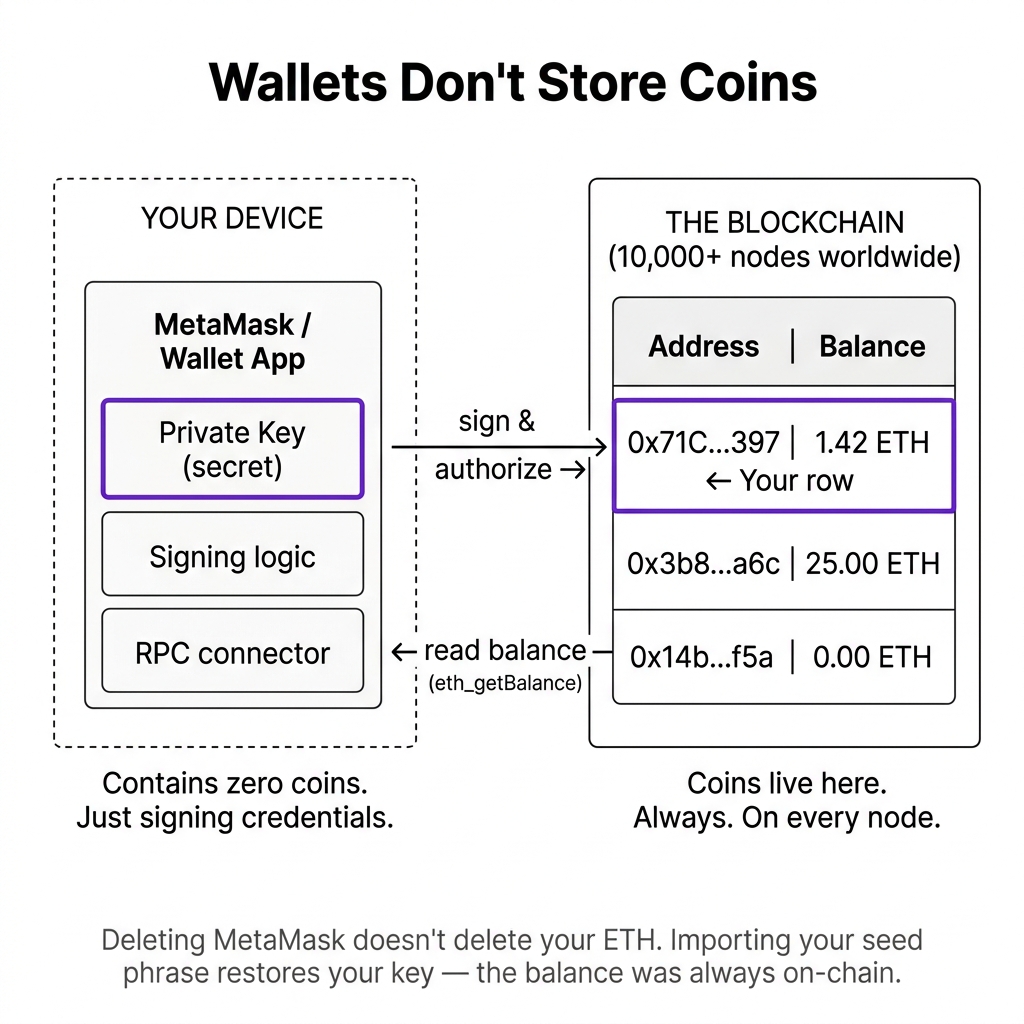
Ethereum, Bitcoin, and all other public blockchains are simply shared global databases. There is a massive spreadsheet running across thousands of validator nodes globally. This spreadsheet maps public addresses (accounts) to balances:
| Account (Public Address) | Balance |
|---|---|
0x71C...397 | 1.42 ETH |
0x3b8...a6c | 25.00 ETH |
0x14b...f5a | 0.00 ETH |
When someone sends you 1 ETH, absolutely nothing is downloaded to your browser or phone. Instead, validators update the global spreadsheet: they subtract 1 ETH from the sender's row and add 1 to your row.
Your wallet is not a vault holding coins. Your wallet is a key manager holding the cryptographic signing credentials (private keys) that authorize updates to your row in the database.
2. The Metaphor: The Glass Mailbox
To understand how this operates, imagine a giant wall of glass mailboxes in a public square:
- The Mailbox Slot (Public Address): Anyone can walk up and drop a letter in. Everyone can look through the glass box and see exactly how many letters are inside. You can share this slot with anyone globally.
- The Mailbox Door (Private Key): The box has a unique mechanical lock. Only you hold the physical metal key (the Private Key) that opens the box.
Your "wallet" is simply the physical metal key you hold in your hand.
- If you lose your key, the letters do not disappear from the glass box. They are still sitting in the public square. But you can never open the door again.
- If someone steals your key, they don't have to steal the physical mailbox. They just walk up, open the door, and take your letters.
Many beginners believe that hardware wallets (like Ledger or Trezor) "store" their crypto offline. In reality, Ledger contains zero coins. It is simply a highly secure, isolated metal key designed to keep your private key offline, signing transaction payloads inside the hardware so that malware on your computer can never swipe the key during execution.
3. Technical Breakdown: Verification vs. Storage
From a system design perspective, a wallet is a wrapper around an Asymmetric Cryptographic Keypair.
When you click "Send" in a wallet app:
- The wallet creates a transaction payload specifying:
FROM: my_address, TO: recipient_address, VALUE: 1 ETH. - The wallet signs this payload using your Private Key (opening the mailbox door) to generate a signature hex string.
- The signed transaction is broadcasted to the P2P network.
- Validators receive the raw payload and signature, run the verification math against your public key to prove you authorized it, and update the global state database.
At no point did any coins enter or leave your browser's memory.
“My ETH is gone!”
Most beginners think deleting MetaMask deletes their funds. This is wrong. MetaMask is just a key manager. Your coins were never inside it.
I once deleted MetaMask in a panic because I thought it was buggy, thinking I had lost all my testnet tokens forever. It wasn't until I imported my seed phrase on a different browser that I realized the state is on the chain, not the application memory. Always keep your seed phrase backed up offline!
Explain the mailbox analogy to a non-technical friend. Make sure to emphasize the difference between their public address (what they share) and their seed phrase (what they must protect).
Was this lesson helpful?
Let us know what you think of this specification. (submitting anonymously)